• Hotline: + 33 (0)1 87 64 13 99 / +44 (0) 20 38 85 06 59 / +1 438-797-0207
Logo Med Assistance chirurgie esthetique Tunisie

Sleeve Tunisia : Sleeve Gastrectomy Surgery for Weight Loss

Bariatric surgery is a way to fight obesity. This type of surgery involves removing or reducing the size of the stomach. Bariatric surgery usually results in rapid weight loss.

Sleeve gastrectomy surgery is one of many types of bariatric surgery. Medical professionals usually call it sleeve gastrectomy (longitudinal gastrectomy).

Sleeve Tunisia: what is the sleeve operation in Tunisia?

Sleeve gastrectomy is a surgical weight loss procedure. It consists of removing a large part of the stomach (about 2/3 of the stomach) and leaving only a small tube in place, the ultimate goal being to limit the amount of food you are able to consume.

Sleeve gastrectomy acts first by restriction (the volume of the stomach is reduced which slows down the passage of food without impacting its digestion), then by reducing the level of ghrelin (which is the hunger hormone, which creates a feeling of rapid satiety). The procedure produces hormonal changes that promote weight loss, thereby helping to treat overweight-related problems such as high blood pressure or cardiovascular disease.

Intended for morbidly obese patients, the sleeve operation in Tunisia allows for significant weight loss: on average about 70% of excess weight over the first 3 years (Parikh et al., Ann Surg 2013). It should be noted that sleeve surgery can only be considered if the obesity in question has been present for many years and is resistant to any other medical treatment (diet, sport, medication).

Sleeve Tunisia price

One of the first questions most obese patients in France and Europe ask is: how much does sleeve gastrectomy surgery cost? Sleeve surgery is a safe and proven weight loss procedure, but the costs of this procedure can be prohibitive in France for many patients.
To understand how much sleeve surgery costs in Tunisia and whether it is worth it, patients need to recognize the overall economic benefits in addition to the health and life-changing benefits.
The price of sleeve surgery in Tunisia, like any other cosmetic surgery performed with Med Assistance includes not only the surgeon’s fees and clinic fees, but also the fees of other medical specialists and nursing staff, anesthesia costs, as well as pre-operative diagnostics.

Sleeve Tunisia price

Interventions Price Stay
Sleeve gastrectomy
4 nights / 5 days

Stomach sleeve surgery in Tunisia: what you need to know before you start

The first step of a sleeve in Tunisia is a complete pre-operative check-up. The patient will need to undergo various tests and laboratory examinations before the surgery. He will have to consult a group of specialists, namely a nutritionist, a cardiologist, an endocrinologist, a pneumologist and a psychiatrist, in order to make sure that the operation does not represent any danger for his health.

Contact us to schedule your sleeve surgery in Tunisia

To schedule a bariatric surgery such as sleeve gastrectomy with Med Assistance Tunisia, call us at + 33 (0)1 87 64 13 99 or fill our online form

How is the sleeve in Tunisia?

The sleeve operation in Tunisia is usually done under general anesthesia. The procedure usually lasts 1 to 2 hours; the length of the hospital stay is set by the surgeon and stated in your quote.

The specifics of your surgery depend on your personal situation and the practices of your surgeon. Some sleeves are performed with large (open) incisions in the abdomen. But the most common practice is laparoscopy, which is performed by inserting small instruments through several small incisions in the upper abdomen.

The surgeon then creates a narrow sleeve (or tube) by stapling the stomach vertically and removing most of it (the part containing the cells that secrete ghrelin).
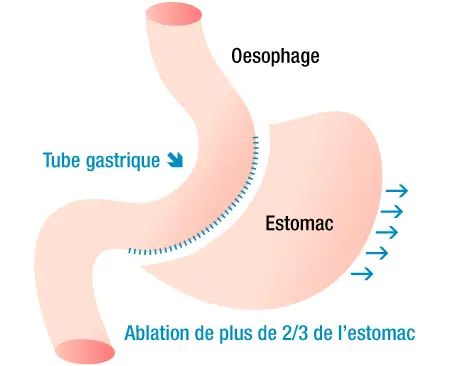

Sleeve Tunisie - Sleeve Gastrectomie

Who is a good candidate for this operation?

Bariatric surgery of any type, including sleeve surgery in Tunisia, is only considered an option when attempts at diet and your exercise habits, as well as the use of weight loss medications, have not worked.

Even then, you must meet certain criteria to be considered for bariatric surgery. These criteria are based on your body mass index (BMI) and whether or not you have an obesity-related health problem.

Eligibility Requirements:

Extreme (morbid) obesity (BMI of 40 or higher).
Obesity (BMI of 35 to 39) with at least one significant obesity-related condition
Sometimes, gastric sleeve surgery in Tunisia is performed if you are overweight but do not meet the criteria for obesity, but have a significant health problem related to your weight.

  • The pain is generally not very important. Simple analgesics are enough to calm them.
    Mobilization is usually resumed quickly. Professional activities can be resumed after 3 to 4 weeks, sports activities after 1 month*.
    During the first week following the operation, the food should be liquid (soup, compotes, yogurt, puree…). For the 2nd and 3rd week, the food must be soft (ratatouille, scrambled eggs…). From the 4th week onwards, the food becomes normal again. It should be noted, however, that tolerance to each food is very variable from one person to another.
  • On average, about 70% of excess weight is lost during the first 3 years (analysis of 112 studies, nearly 10,000 patients – Parikh et al., Ann Surg 2013); 5 years after surgery, the average loss is about 58% of excess weight (Juodeikis and Brimas, Surg Obes Relat Dis 2017).
  • Weight loss is fastest in the first weeks, then slows down; most people reach their lowest weight 12 to 24 months after surgery.
  • Results vary from one person to another and depend strongly on nutritional follow-up and physical activity after surgery.

Bariatric surgery of any type, including sleeve surgery in Tunisia, is only considered an option when attempts at diet and your exercise habits, as well as the use of weight loss medications, have not worked.

Even then, you must meet certain criteria to be considered for bariatric surgery. These criteria are based on your body mass index (BMI) and whether or not you have an obesity-related health problem.

Eligibility Requirements:

Extreme (morbid) obesity (BMI of 40 or higher).
Obesity (BMI of 35 to 39) with at least one significant obesity-related condition
Sometimes, gastric sleeve surgery in Tunisia is performed if you are overweight but do not meet the criteria for obesity, but have a significant health problem related to your weight.

With weight loss, many obesity-related health problems can improve or resolve, for example:

Type 2 diabetes: five years after a sleeve, remission or improvement was observed in 77.8% of diabetic patients (review of 20 studies – Juodeikis and Brimas, Surg Obes Relat Dis 2017)
High blood pressure
Fatty liver disease
High cholesterol
Sleep apnea
Risk of some obesity-related cancers
Polycystic ovary syndrome
Asthma
Migraine
Joint pain
Depression and other psychosocial problems
Infertility
Low testosterone levels
Urinary incontinence

With improved surgical techniques and surgeons’ experience, the sleeve has become a common and generally safe bariatric operation. Complications can nevertheless occur during and after surgery; the surgeon explains them to you during the consultation. The main ones are:

  • Leak (fistula) at the staple line: a rare but serious complication, seen in 2.2% of patients in an analysis of 112 studies (Parikh et al., Ann Surg 2013). Fever, abdominal pain, shortness of breath or a racing heart after surgery require immediate medical attention.
  • Functional stenosis (narrowing of the gastric tube without anatomical narrowing): a rare complication caused by a twist of the staple line.
  • Bleeding.
  • Blood clot (phlebitis, pulmonary embolism): early walking, compression stockings and anticoagulant treatment, if prescribed, help prevent it.
  • Reflux (heartburn): it may improve with weight loss in some patients, but appear or worsen in others; it is usually treated with medication prescribed by the doctor. Revision surgery for reflux was needed in 2.9% of patients followed for 7 years or more (Clapp et al., Surg Obes Relat Dis 2018).
  • Nutrient or vitamin deficiency: supplements and regular blood tests are needed in the long term.
  • Weight regain: slight regain after 1 to 2 years is common; among patients followed for 7 years or more, significant weight regain was observed in 27.8% (Clapp et al., 2018). Nutritional follow-up and physical activity remain essential.
  • Excess skin: after major weight loss, surgery to remove excess skin may be considered once weight has stabilised.

Day 1 to 3: fasting with an infusion. Some surgeons allow patients to drink water a few hours after the sleeve operation in Tunisia

Day 3-14: Full liquid diet including protein shakes, yogurt, broth, milk and juice

Weeks 3 to 5: Gentle diet

Patients can begin to introduce a regular diet 5 weeks after surgery. They are encouraged to eat a small amount of food each time and to eat more frequent meals.

All patients should change their eating habits and take multivitamins and B vitamins after surgery

A sleeve may be preferred, for example, when a gastric bypass would carry particular risks for you; conversely, significant reflux may make a bypass the better option.

You should discuss all available surgical procedures with your surgeon, get his or her opinion about sleeve surgery in Tunisia and determine which one is best for you.

Comparison of the sleeve in Tunisia with other types of bariatric procedures

Laparoscopic gastric banding was once very popular. However, because of its poor weight loss for some patients, the number of band surgeries has declined. 

Laparoscopic gastric bypass is the gold standard of bariatric surgery. However, gastric bypass surgery has been replaced by Sleeve gastrectomy as the most popular bariatric surgery in recent years due to its technical simplicity and lower long-term complication rates.

Advantage of the sleeve in Tunisia compared to the gastric bypass

Technically, sleeve gastrectomy is a simpler and generally shorter operation than gastric bypass.

The sleeve does not bypass the intestine: there is no malabsorption, and the risk of deficiency is lower than after a bypass. Vitamin supplements and regular blood tests are still needed.

Some long-term complications can occur in gastric bypass patients, including intestinal obstruction, marginal ulcer and internal hernia. These bypass-specific complications do not concern the sleeve, which does not change the intestinal route; the sleeve, however, carries a higher risk of reflux.

Get a free quote

Logo Med Assistance chirurgie esthetique Tunisie
Address
Les Berges du Lac, Tunis 1053, Tunisia
Contact
Phone

+ 33 (0)1 87 64 13 99

+44 (0) 20 38 85 06 59

+1 438-797-0207

Whatsapp

+ 216 58 514 456

E-mail

contact@medassistance.fr

Follow us