
Buttock Augmentation Tunisia: What is Buttock Surgery?
Buttock augmentation through fat injection or implants is a body contouring surgery that aims to improve the contour, size and/or shape of the buttocks. This procedure is designed for women who find their buttocks too flat or sagging and want to remedy this. The procedure increases the volume of the buttocks to achieve a full, well-rounded shape.
Buttock Augmentation with Buttock Implants (Prostheses)
Buttock implants used in Tunisia are as flexible as breast implants and look just as natural. With excellent reliability, they are composed of:
- Cohesive silicone gel. Its consistency is less fluid than breast implants, in order to limit the risk of leakage in case of envelope rupture.
- An envelope with a very strong and resistant wall to prevent gel transpiration (even in the case of a wall crack).
Buttock Augmentation Prices in Tunisia
The cost of buttock augmentation depends on the surgical technique you choose, whether you opt for implants or fat transfer lipofilling. Once decided, your advisor will help you estimate the cosmetic surgery cost and send you a detailed quote.
Buttock augmentation in Tunisia with implants costs €3,200 and this includes surgeon and anaesthetist fees as well as the medical stay at the clinic and hotel. Buttock fat injection: the price in Tunisia is €2,850.
Buttock implant: price in Tunisia
| Procedures | Price | Stay |
|---|---|---|
| Buttock augmentation with buttock implants | €3,200 | 6 nights / 7 days |
Get a free quote
Buttock Augmentation in Tunisia: Choosing Between Buttock Implants or Fat Transfer (BBL – Brazilian Butt Lift)?
This is, to some extent, a matter of choice. Your surgeon will help you make the decision that best suits your body and meets your expectations and requirements. In some cases, it may be necessary to complement buttock augmentation in Tunisia with implants using your own fat, especially if you have a lot of fat in other areas.
The disadvantage of buttock fat transfer is that the fat is sometimes reabsorbed. Your surgeon will be able to advise you on how to ensure a successful lipofilling. Another advantage of this procedure is that fat cells must be removed from other areas of your body through liposuction such as the abdomen, thighs or hips.
Buttock augmentation in Tunisia with implants generally produces a more significant size increase than fat transfer lipofilling.
Buttock implant sizes in Tunisia generally range from 200 ml (cc) to 560 ml (cc) per implant.
With lipofilling, however, a large number of buttock injections or multiple BBL procedures would be needed to achieve a similar degree of augmentation with implants.
Buttock augmentation in Tunisia with implants is also a good choice if the patient lacks sufficient fat for injection into the buttocks, or prefers a longer-lasting result than fat injection.
Buttock Augmentation in Tunisia with Implants: Everything You Need to Know Before Getting Started
The first step in a buttock augmentation procedure in Tunisia is the pre-operative assessment. The surgeon asks you questions about your general health and performs a morphological examination of the buttocks and silhouette to assess the quality of your skin. They then discuss your expectations with you. This allows them to determine the appropriate size and shape of buttock implants (adapted to your body type) so that the result looks as natural as possible. The surgeon must also give their opinion and inform you of the risks, recovery time and cost of buttock augmentation in Tunisia.
- *Disclaimer: results may vary from person to person depending on patient morphology.
How Buttock Surgery is Performed in Tunisia
Buttock augmentation in Tunisia is performed under general or epidural anaesthesia. It lasts approximately 2 hours and requires 2 to 3 days of hospitalisation.
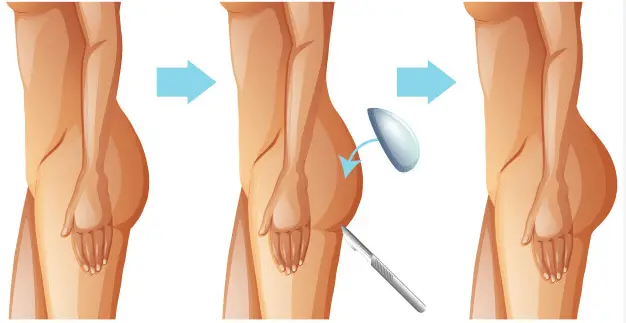
Buttock augmentation with implants is performed through an intergluteal approach. The surgeon begins by making a vertical incision in the crease between the two buttocks (gluteal cleft). This avoids a visible future scar.
The surgeon then proceeds to place the implants through the incision. The implants are introduced into the prepared pockets. Positioning is generally intramuscular, i.e. within the gluteus maximus muscle.
Once the implants are in place, the surgeon proceeds to drainage to evacuate any blood that may have accumulated around the prostheses. A shaping dressing is then applied before the patient wakes up. This dressing is usually made with an elastic bandage or compression garment. It is designed to facilitate healing.
Post-Operative Recovery After Buttock Surgery in Tunisia
- Following buttock augmentation in Tunisia, pain is rarely significant. A prescription for pain medication helps manage it.
- There is generally swelling (oedema) and bruising (ecchymosis) in the treated areas. These disappear within 10 days after surgery.
- You should avoid sitting for 24 hours and walking for 48 hours. A fitted compression garment must be worn day and night for 1 month.
- Daily activities can be resumed after 3 weeks. Sports activities involving the gluteal muscles should be avoided for 3 months.
– Regarding anaesthesia, during the consultation, the anaesthetist will personally inform the patient of the anaesthetic risks. Having recourse to a perfectly competent anaesthetist, practising in a genuine surgical context, means that the risks incurred are more or less easy to manage.
It should indeed be kept in mind that techniques, anaesthetic products and monitoring methods have made immense progress over the past thirty years, offering optimal safety, especially when the procedure is performed outside of an emergency and on a healthy person.
– Regarding the surgical procedure: by choosing a qualified and competent Plastic Surgeon trained in this type of cosmetic surgery, you minimise these risks as much as possible, without however completely eliminating them.
In practice, the vast majority of buttock augmentation surgeries with implants performed according to the rules proceed without any problems, post-operative recovery is straightforward and patients are fully satisfied with their results.
However, sometimes a risk of complications may arise during or after the procedure, some inherent to the surgical procedure and others specifically related to the implants:
– Haematoma: If significant, a return to the operating theatre is preferable to evacuate the blood and stop the bleeding at its source.
– Serous effusion: It disappears spontaneously and progressively.
– Infection: It is rare after this type of surgery.
– Scarring abnormalities
– Sensitivity changes: These are common in the first months but usually subside over time.
Risks specifically related to implants
– Formation of “folds” or “wave” appearance
– “Capsular contracture”: Great progress has been made in recent years in the design and composition of implants, leading to a very significant reduction in the rate and severity of capsular contracture.
– Rupture: This usually requires surgery to replace the implants.
– Malposition, displacement: May sometimes require surgical correction.
– Rotation: Although relatively rare in practice, rotation of an “anatomical” prosthesis remains theoretically possible.
Thigh lift
Buttock fat transfer